
Many security teams do not fail because they lack tools. They fail because they treat threat, vulnerability, and risk as synonyms. In practice, that leads to poor prioritization: a medium-severity internet-facing weakness with active exploitation may be more urgent than a higher-CVSS issue on an isolated internal host.
To use these concepts correctly, teams need to understand what each term means and how they connect in real decision-making.
What Is Threat, Vulnerability, And Risk
Before we dig into the details of the article, it is better to have a basic understanding of the terms mentioned.
A vulnerability is a flaw or weakness in hardware, software, or organizational processes that can be exploited by an attacker (e.g., outdated software, weak passwords within the system, misconfigured access control).
A threat is any actor, event, or circumstance that can exploit a vulnerability and cause harm to systems, assets, or data (e.g., hackers, malware, insider misuse, or natural disasters).
To avoid confusion, it helps to separate three related ideas:
- threat source - who or what can cause harm;
- threat event - what actually happens;
- vulnerability - the weakness that can be exploited.
Risk appears when those elements combine with likelihood and impact.
Risk is the potential for loss or damage when a threat exploits a vulnerability. It can be expressed as a simple formula: Risk = Likelihood × Impact. In other words, risk depends on both the likelihood of exploitation and the potential impact.
How do Threat, Vulnerability and Risk Relate?
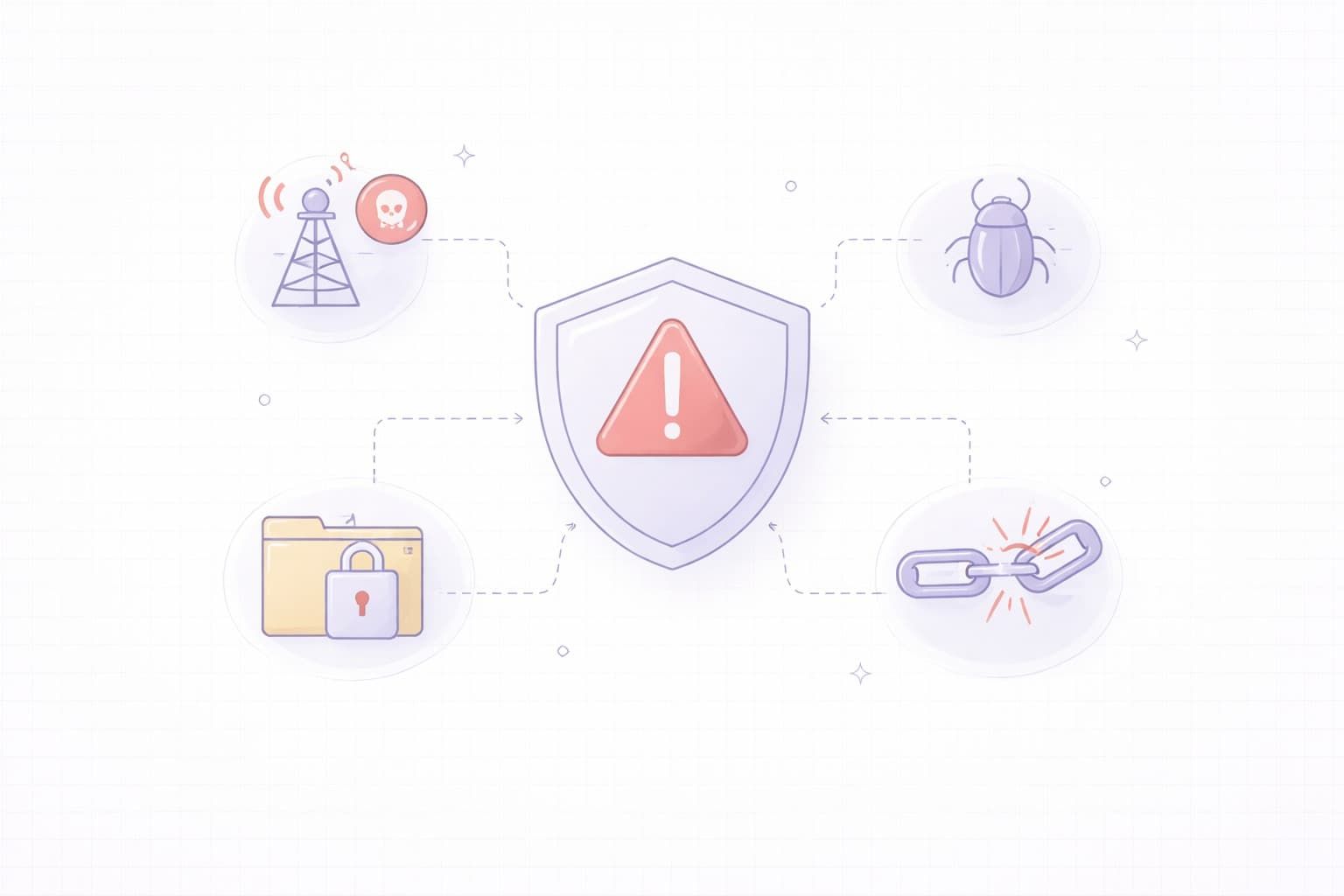
A more useful model is: Threat source - Threat event - Vulnerability or predisposing condition - Impact - Risk.
Risk becomes material when a relevant threat can exploit a real weakness and create meaningful impact. Let’s take an example here: even if you do not see active targeting against your organization today, the risk may still be material if the weakness is internet-facing, easy to exploit, or already known to be exploited elsewhere. Current targeting is only one signal, not the whole picture. By contrast, a high-impact threat targeting a critical unpatched vulnerability significantly increases overall risk.
Organizations use this distinction to build and improve risk management frameworks. To build such a framework, security teams first identify weaknesses in their systems, then analyze relevant threats, and finally estimate the resulting risk to decide which controls should be implemented.
Below, have a look at the summarized version of their relationship:
- Vulnerabilities = “Where are we weak within our systems?”
- Threats = “What could realistically go wrong here?”
- Risks = “What could happen if a threat exploits this vulnerability?"
Table 1. How security teams use these terms in practice
|
Question |
What the team checks |
Example decision |
|
Threat - What could cause harm here? |
Whether there is a realistic threat source or event, such as active exploitation in the wild, known attacker interest, phishing activity, ransomware campaigns, insider misuse, or exposed services that are commonly targeted. |
Move the issue up in priority because the weakness matches a technique or vulnerability that attackers are already using. |
|
Vulnerability - What weakness makes this possible? |
Whether there is a real flaw, misconfiguration, weak control, or process gap in the environment, such as an unpatched service, exposed admin panel, weak password policy, excessive permissions, or public cloud storage. |
Confirm the weakness, assign an owner, and define the most practical fix or compensating control. |
|
Risk - What happens if the threat exploits the weakness? |
How likely exploitation is and what the business impact would be, including service disruption, sensitive data exposure, regulatory consequences, customer harm, financial loss, or damage to operations. |
Escalate the issue because the affected asset supports authentication, payments, sensitive records, or another critical business function. |
|
Exposure - How reachable is the weakness in practice? |
Whether the affected asset is internet-facing, accessible through a partner connection, available to many internal users, or protected by segmentation, MFA, allowlists, or other controls. |
Raise priority because the weakness is externally reachable, or lower urgency because strong controls significantly limit access. |
|
Control decision - What should we do next? |
Which action reduces risk most effectively: patching, hardening, restricting access, rotating secrets, adding monitoring, applying temporary mitigation, or formally accepting the risk with documented justification. |
Patch immediately, block access temporarily, assign follow-up monitoring, or document why the risk is being accepted for a limited period. |
Differences at a Glance
Table 2. Threat, vulnerability, risk, and exposure at a glance
|
Term |
Simplest question |
What analysts look at |
Common mistake |
Example decision |
|
Threat |
What could cause harm here? |
Threat actors, attack techniques, phishing activity, malware campaigns, insider misuse, public exploit activity, and sector-specific targeting. |
Treating every possible threat as equally urgent, even when there is little evidence it is relevant to the environment. |
Raise priority because the weakness matches a technique or vulnerability already being exploited in the wild. |
|
Vulnerability |
What weakness makes this possible? |
Unpatched software, misconfigurations, weak controls, exposed services, excessive permissions, insecure defaults, or process gaps. |
Assuming a scanner finding automatically means a real and reachable weakness without validation. |
Confirm the weakness, assign an owner, and define the most practical remediation step. |
|
Exposure |
How reachable is the weakness in practice? |
Whether the asset is internet-facing, broadly accessible internally, reachable through a partner connection, or restricted by segmentation, MFA, or allowlists. |
Ignoring reachability and treating an isolated internal issue as urgent as an externally reachable one. |
Move the issue higher because the affected service is publicly reachable from the internet. |
|
Risk |
What happens if the threat exploits the weakness? |
Likelihood of exploitation, business impact, affected data, operational dependency, regulatory exposure, customer impact, and recovery difficulty. |
Using severity alone as a business risk score without considering exposure, impact, or controls. |
Escalate the issue because the vulnerable asset supports authentication, payments, or sensitive records. |
|
Control decision |
What should we do next? |
Whether patching, hardening, access restriction, secret rotation, added monitoring, temporary mitigation, or formal risk acceptance reduces risk most effectively. |
Focusing only on the technical fix and ignoring ownership, timelines, or verification of remediation. |
Patch immediately, block access temporarily, add monitoring, or document a time-limited risk acceptance with clear justification. |
Scenarios & Examples
The examples below illustrate the difference between threat, vulnerability, and risk.
Scenario 1: Ransomware Attack
- Threat - a ransomware group targeting a hospital database.
- Vulnerability - outdated Windows servers in the hospital environment are missing critical security updates.
- Risk - patient and staff records could be encrypted, leading to system downtime, loss of trust, and regulatory penalties for the hospital.
Scenario 2: Insider Data Leakage
- Threat - a malicious employee or an authorized user misusing legitimate access to export sensitive files.
- Vulnerability - a lack of data loss prevention (DLP) monitoring and related internal controls.
- Risk - intellectual property exposure and competitive disadvantage since confidential information could be breached.
Scenario 3: Cloud Misconfiguration
- Threat - attackers scanning public S3 buckets.
- Vulnerability - misconfigured access permissions allowing public read access.
- Risk - leakage of confidential information and reputational damage.
These examples show something more specific: reducing vulnerabilities lowers risk only when the weakness is real, reachable, tied to an exposed asset, and not already mitigated by other controls.
Table 3. Real-world examples of threat, vulnerability, and risk
|
Incident |
Threat |
Vulnerability |
Risk |
Main lesson |
|
Equifax (2017) |
External attackers exploited a public-facing web application handling consumer dispute data. |
An unpatched Apache Struts vulnerability, identified by Equifax as CVE-2017-5638, in the online dispute portal. |
Large-scale exposure of personal data, regulatory consequences, reputational damage, and long-term business impact. |
A known vulnerability becomes a major risk when it remains unpatched on a critical internet-facing service. |
|
Capital One (2019) |
An external attacker targeted a cloud-hosted environment and obtained unauthorized access to sensitive data. |
A configuration weakness reported through Capital One’s Responsible Disclosure Program. According to the U.S. Department of Justice, the intrusion occurred through a misconfigured web application firewall. |
Exposure of customer and applicant data, regulatory fallout, litigation costs, and loss of trust. |
Cloud risk is often driven by misconfiguration and access control weaknesses, not only by software bugs. |
|
MOVEit Transfer (2023) |
CL0P targeted internet-facing MOVEit Transfer systems and deployed the LEMURLOOT web shell to support follow-on abuse. |
CVE-2023-34362 in public-facing MOVEit Transfer web applications. |
Data theft, extortion pressure, operational disruption, and widespread third-party impact across affected organizations. |
When a vulnerable service is externally reachable and exploitation is already active, speed of validation and remediation matters as much as detection. |
Controls & Access Control Mapping
Controls are safeguards designed to reduce the likelihood or impact of threats exploiting vulnerabilities. They can be administrative, technical, or physical. Access control mapping links user roles, permissions, systems, and resources to specific security controls.
This becomes easier to understand in practice. If the threat is stolen admin credentials, the vulnerability may be weak authentication or excessive privileges, so the relevant controls include phishing-resistant MFA, least-privilege access, unusual activity monitoring, and rapid session revocation. If the threat is public exposure of cloud data, the vulnerability may be overly permissive storage settings, which calls for blocked public access by default, configuration monitoring, and fast permission cleanup. If the threat is insider data leakage, the vulnerability may be excessive access and weak oversight, so stronger role-based access, DLP, and audit logging become more important.
These examples show how preventive, detective, and corrective controls should be mapped to specific threat-vulnerability pairs rather than applied as abstract categories.
Measuring Risk
Risk measurement brings together likelihood (how likely an event or situation is) with impact (how great the consequences are of that anticipated exploitation). One of the more popular formulas is: Risk = Likelihood × Impact. This is a useful shortcut, not a complete model. In practice, teams also consider exposure, reachability, business criticality, exploitation evidence, and existing controls.
Organizations often use several methods to assess risk, including CVSS for technical severity, NIST SP 800-30 for risk assessment methodology, and ISO 27005 for broader risk management alignment.
Qualitative evaluations rank risk as low, medium, or high, whereas quantitative ones utilize metrics such as expected annual loss (EAL).
Risk measurement helps prioritize security investments: patch crucial systems first, implement compensating controls for medium risks, and continuously watch low-risk areas.
"The most expensive mistake is not leaving one medium finding open. It is leaving the wrong medium finding open - the one that is internet-facing, easy to reach, and tied to a critical business function."