
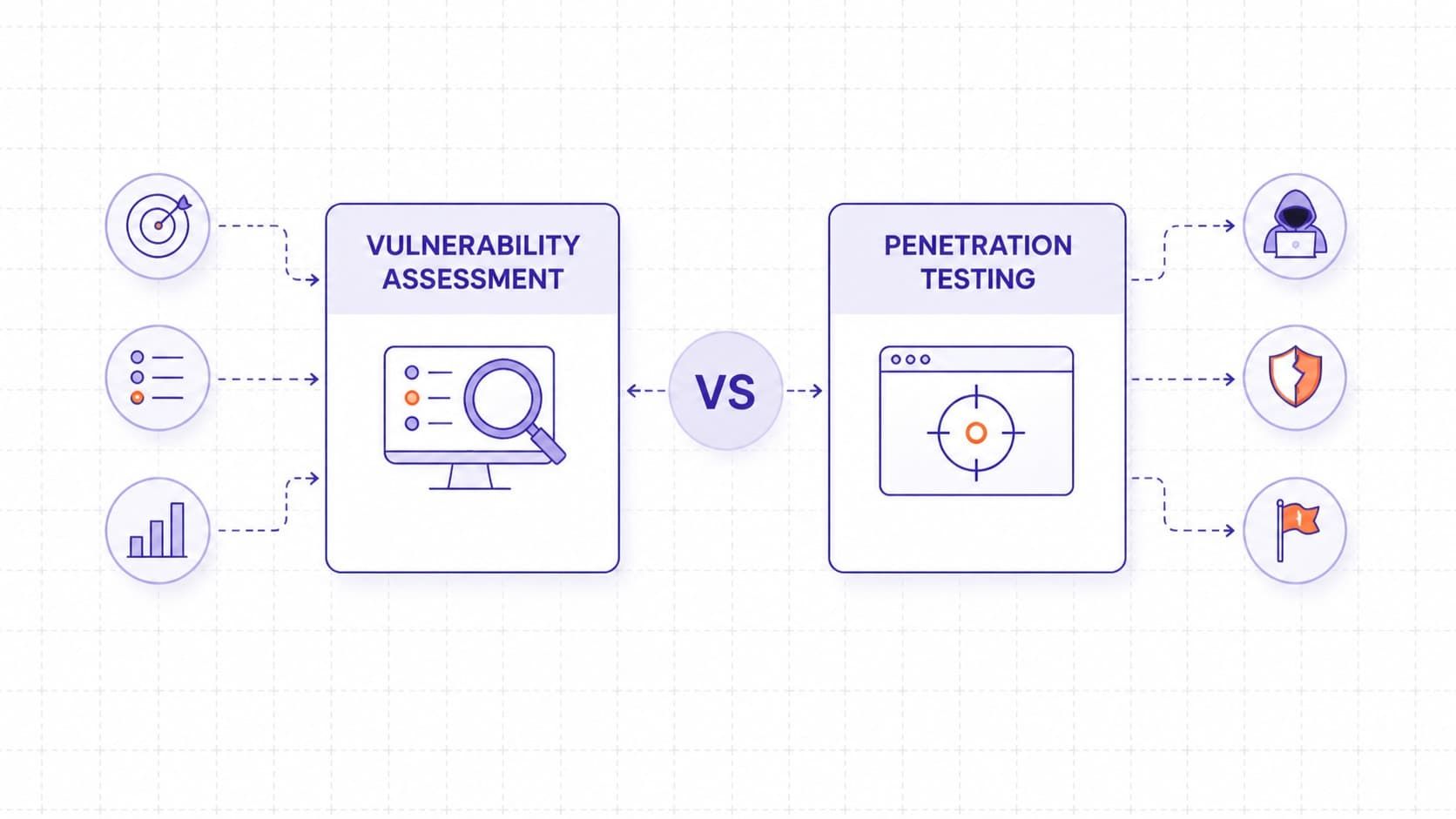
A vulnerability assessment identifies known weaknesses across systems, applications, networks, APIs, cloud assets, or other parts of an IT environment. It is usually broad, repeatable, and focused on finding, prioritizing, and fixing issues at scale. Penetration testing goes deeper into a narrower scope by simulating real attack techniques to prove whether weaknesses can be exploited and what impact they could have. In simple terms, vulnerability assessment tells you what may be weak; penetration testing shows what an attacker could actually do with those weaknesses.
The most common mistake is to choose between vulnerability assessment and penetration testing as if they were competing services. In practice, they answer different questions: one helps you find weaknesses at scale, while the other shows which of them could lead to real business risk.
| Factor | Vulnerability Assessment | Penetration Testing |
|---|---|---|
| Main goal | Find and prioritize known weaknesses | Validate exploitability and business impact |
| Scope | Broad coverage across many assets | Narrower, focused target or scenario |
| Depth | Usually less deep per finding | Deeper manual validation |
| Method | Mostly scanning, analysis, and triage | Manual testing, exploitation, and evidence collection |
| Output | Findings list, severity, affected assets, remediation guidance | Attack paths, proof of exploitation, impact, remediation, retest notes |
| Best for | Continuous visibility and remediation planning | Proving real-world risk and testing controls |
| Frequency | Recurring or continuous | Periodic, after major changes, or for compliance |
| Limitation | May include false positives or unvalidated risk | Does not provide broad continuous coverage |
Assessment vs Scanning vs Pentesting vs VAPT
These terms are related, but they are not interchangeable.
Vulnerability scanning is the technical process of using automated tools to detect known weaknesses, exposed services, missing patches, insecure configurations, or vulnerable software.
Vulnerability assessment is the broader process around those findings. It includes scanning, analysis, false-positive review, severity and business context, reporting, remediation planning, and rescanning.
Penetration testing is a controlled security exercise where testers attempt to exploit weaknesses, chain issues together, and show what impact an attacker could realistically achieve.
VAPT stands for vulnerability assessment and penetration testing. It usually means using both approaches together: assessment for broad visibility, and penetration testing for deeper validation of selected risks.
Vulnerability Assessment Defined
A vulnerability assessment is the process of identifying security weaknesses in an IT environment. That environment may include systems, applications, networks, APIs, cloud resources, and other assets. The goal is to find known weaknesses, analyze them, and support remediation before an attacker can exploit them.
A typical vulnerability assessment includes:
- scanning to identify security weaknesses;
- analyzing the findings;
- assessing the severity and relevance of the issues;
- producing reports to guide remediation.
Vulnerability assessment is usually one of the first stages of a broader vulnerability management process. It helps teams decide what to fix, in what order, and how to verify that the fixes worked.
A vulnerability assessment creates value only when findings are assigned to owners, fixed, and rescanned. Without that follow-through, even a well-scoped assessment becomes a static list instead of a risk-reduction process.
Penetration Testing Defined
Penetration testing is a security exercise in which testers attempt to identify and validate exploitable weaknesses by simulating real-world attacks against systems, applications, or networks. NIST SP 800-115 groups penetration testing among techniques used to validate the existence of vulnerabilities.
Unlike a vulnerability assessment, a penetration test does not stop at detection. Its purpose is to determine whether weaknesses can actually be exploited, how far an attacker could get, and what business impact that could have. Penetration tests are performed under agreed rules of engagement and are meant to be controlled and non-destructive.
Comparing Vulnerability Assessment and Penetration Testing Workflows
The two workflows can look similar at a high level because both involve planning, discovery, analysis, reporting, and follow-up. The difference lies in the goal and how the work is done.
Vulnerability Assessment Workflow
A typical vulnerability assessment workflow includes:
- Scoping and planning - define the goal of the assessment and choose the assets to include.
- Asset discovery - build an inventory of the systems, applications, databases, endpoints, or cloud resources to assess.
- Vulnerability scanning - use automated tools to identify known weaknesses. NIST SP 800-115 includes vulnerability scanning as a standard testing technique. These tools usually rely on sources such as NIST's NVD and vendor advisories for detection, while CISA's Known Exploited Vulnerabilities Catalog is more useful for prioritization because it tracks vulnerabilities known to be exploited in the wild.
- Analysis and triage - remove false positives, duplicates, and findings that are not relevant to the environment.
- Risk prioritization - rank issues based on exploitability, exposure, asset criticality, and likely business impact.
- Reporting - produce technical and management-facing reports.
- Remediation and rescanning - apply fixes and scan again to verify that the issues are resolved.
Vulnerability assessment is cyclical. After remediation, the environment is scanned again, and the process continues.
Penetration Testing Workflow
A typical penetration testing workflow includes:
- Scope and rules of engagement - define what will be tested, under what conditions, over what timeframe, and with what legal or operational restrictions. PTES treats pre-engagement as a formal stage of the test.
- Reconnaissance - gather information about the target through public or authorized internal sources. PTES includes intelligence gathering as one of its core phases.
- Exploitation and validation - attempt to exploit weaknesses and, where relevant, chain multiple issues together.
- Post-exploitation - determine what an attacker could do after initial compromise, such as privilege escalation, lateral movement, or access to sensitive data.
- Impact proof - document the actual business or technical impact with clear evidence.
- Retesting - verify that fixes work and that the tested weakness is no longer exploitable.
Penetration testing is more manual and contextual, with a stronger focus on proof than on broad coverage.
Differences in Methodologies and Frameworks
Vulnerability assessments and penetration tests both benefit from structured methodologies, but penetration testing is usually guided by more formalized frameworks.
For vulnerability assessments, NIST SP 800-115 is relevant because it covers vulnerability scanning, and NIST SP 800-40 Rev. 4 provides guidance on patch management planning and remediation processes.
For penetration testing, PTES is one of the best-known public methodologies, and OSSTMM is another framework teams may use depending on scope and testing style. PTES defines seven main sections, including pre-engagement, intelligence gathering, exploitation-related phases, and reporting.
Differences in Scope Decisions
Scope is usually defined differently for vulnerability assessments and penetration tests.
In a vulnerability assessment, the scope is usually broader. The goal is to cover as many known assets as practical so the organization gets wide visibility into weaknesses. That often means including servers, endpoints, APIs, cloud resources, and supporting systems, even when some of them are not business-critical.
In a penetration test, the scope is usually narrower and more targeted. The focus is on the systems, paths, or scenarios that could create the highest business impact if exploited. A penetration test is less about covering every asset and more about finding where an attacker could cause the most damage.
Tools for Vulnerability Assessments and Penetration Tests
Vulnerability assessments usually rely on platforms that support repeated scanning, discovery, reporting, and rescanning. These can include cloud-native services and dedicated vulnerability management tools.
Penetration testers usually use a mix of tools rather than one platform. Different tools support different phases, such as reconnaissance, validation, exploitation, and reporting. Testers often combine several tools depending on the scope and the environment.
Penetration Testing Reports vs Vulnerability Assessment Reports
Both approaches end with reporting, but the reports are different in structure and purpose.
A vulnerability assessment report usually includes:
- an executive summary;
- scope and scan coverage;
- a list of findings;
- severity ratings;
- remediation recommendations.
A penetration testing report usually includes:
- an executive summary;
- scope and methodology;
- attack paths and exploit chains;
- screenshots, logs, or proof-of-concept evidence;
- business impact analysis;
- remediation guidance and retest results. PTES reporting guidance explicitly calls for scope, attack path, impact, and remediation content in the technical report.
|
Aspect |
Vulnerability Assessment Report |
Penetration Testing Report |
|
Writer |
Usually generated by tools and validated by an analyst. |
Usually written manually by the tester. |
|
Coverage |
Broad, across scanned assets. |
Narrow, focused on agreed targets. |
|
Main content |
Findings, severity, and affected assets. |
Exploit chains, evidence, and impact scenarios. |
|
Evidence |
Mostly technical details and screenshots. |
Screenshots, payloads, logs, and proof of exploitation. |
|
Remediation |
Patch and configuration guidance. |
Fixes tied to real attack paths. |
|
Validation |
Rescan. |
Retest. |
When to Use Vulnerability Assessments, Penetration Tests, or Both
Use a vulnerability assessment when you need broad, recurring visibility into known weaknesses across your environment. It is the better fit when the goal is to discover exposed systems, missing patches, insecure configurations, vulnerable software, and remediation priorities across many assets.
Use penetration testing when you need proof of exploitability. It is the better fit when the question is not only “what is vulnerable?” but “can this be exploited, how far could an attacker get, and what would the business impact be?”
Use both when the system is important, internet-facing, regulated, recently changed, or repeatedly producing high-risk findings. Vulnerability assessment gives coverage; penetration testing gives validation. Together, they help teams move from a long list of possible weaknesses to a clearer view of which risks matter most.
| Situation | Best choice | Why |
|---|---|---|
| You need to find known weaknesses across many assets | Vulnerability assessment | It provides broad, repeatable coverage |
| You need to verify whether a weakness is exploitable | Penetration testing | It validates real attack paths |
| You are preparing for SOC 2, ISO 27001, PCI DSS, or customer security review | Both | Assessment supports coverage; pentesting supports proof |
| You changed architecture, authentication, cloud exposure, or critical application logic | Both | New exposure needs scanning and targeted validation |
| You have many findings and need remediation priorities | Vulnerability assessment first | It builds the risk backlog and supports triage |
| You need executive evidence of business impact | Penetration testing | It produces attack-path and impact-based reporting |
Relationship to Vulnerability Management and Compliance
Used together, vulnerability assessments and penetration tests strengthen a vulnerability management program by combining broad visibility with real-world validation.
The strongest programs use both methods deliberately, not just because a checklist requires them. Broad scanning gives coverage, but focused testing shows whether an attacker could chain weaknesses, bypass controls, and cause damage that a severity score alone would not fully capture.
They also matter for compliance. For example, PCI DSS v4.0 separates vulnerability scanning and penetration testing into different requirements: Requirement 11.3 covers internal and external vulnerability scans, while Requirement 11.4 covers penetration testing. Requirement 11.4.1 goes further by requiring a defined, documented, and implemented penetration testing methodology.
If your organization handles payment data, using both vulnerability assessments and penetration tests can help support PCI DSS compliance.
Recommended Testing Frequency
Testing frequency should be based on the organization's risk profile, asset exposure, rate of change, and compliance obligations.
NIST SP 800-53 Rev. 5 distinguishes between ongoing vulnerability monitoring and separate penetration testing activities through controls such as RA-5 and CA-8. In practice, this supports a model where vulnerability assessments are performed continuously or on a recurring schedule, while penetration tests are conducted periodically and after significant changes.
For public-facing or mission-critical systems, vulnerability assessments usually need to be more frequent because exposure can change quickly. Penetration testing is commonly scheduled at planned intervals as part of the broader security program, and it is especially valuable after major architectural, infrastructure, or application changes.
Summary
Vulnerability assessments and penetration tests both improve security, but they do so in different ways. Vulnerability assessments provide broad, repeatable visibility into known weaknesses. Penetration tests validate exploitability and demonstrate business impact.
A strong security program usually needs both. One helps you see the backlog of weaknesses across the environment. The other helps you show which weaknesses matter most in a realistic attack scenario.