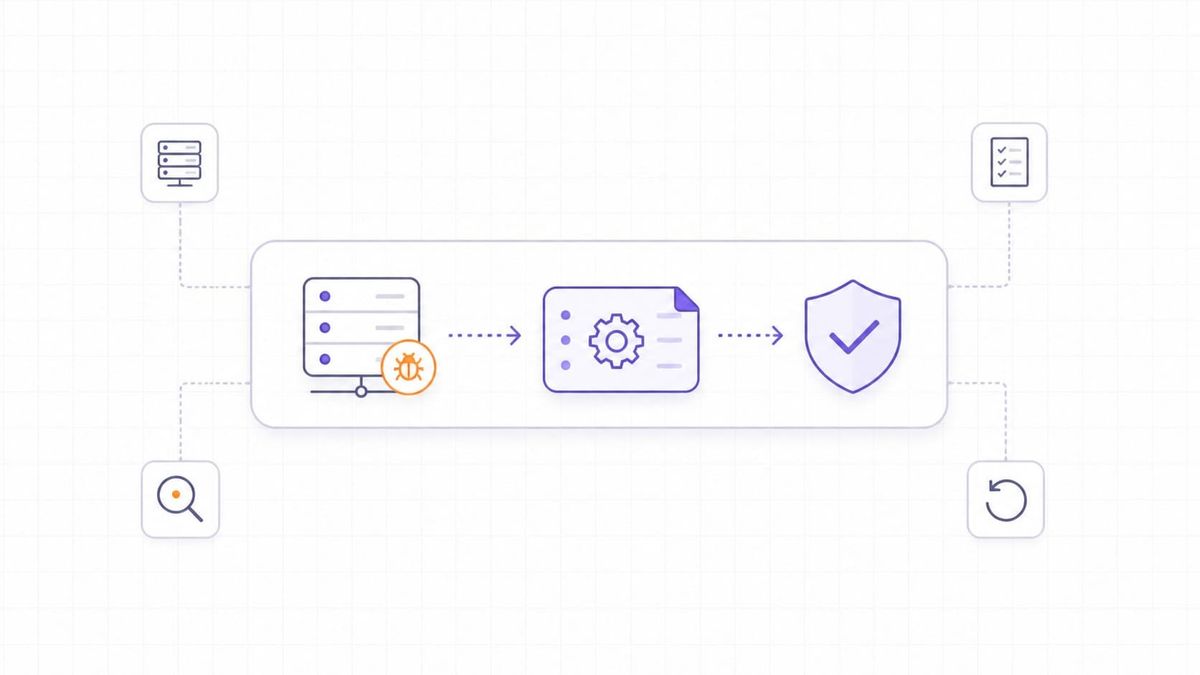

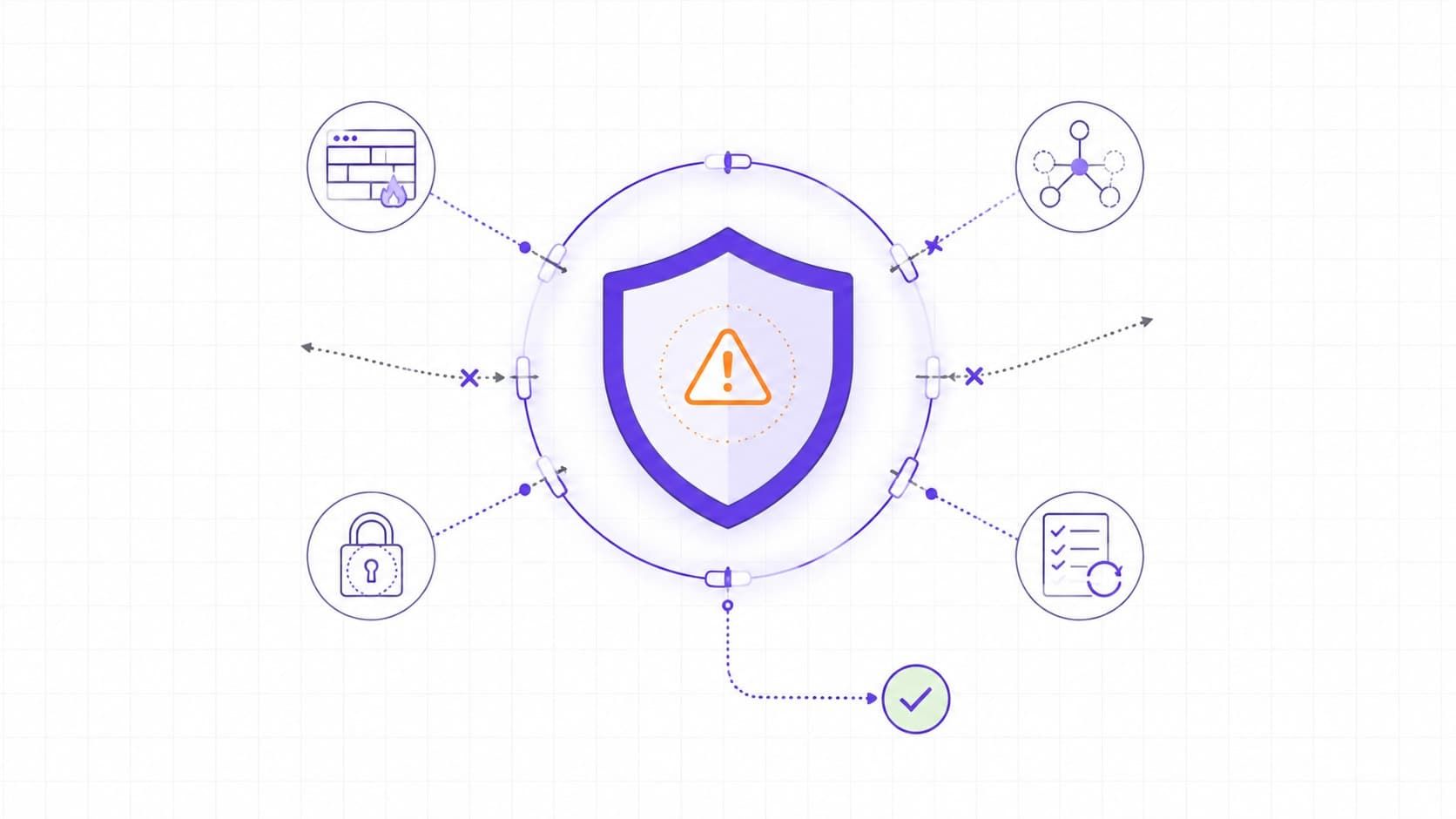
Vulnerability mitigation is a risk response: a team changes the conditions around a weakness so that exploitation becomes less likely or less damaging. It may restrict access, disable a vulnerable feature, isolate an asset, reduce privileges, or add monitoring while engineers prepare a permanent fix.
The distinction matters because a mitigation can be effective without removing the underlying vulnerability. It must therefore have an owner, evidence, a review date, and a path to remediation. Otherwise, a temporary safeguard can quietly become an unmanaged exception.
Vulnerability Mitigation Reduces Risk While the Weakness Remains
The NIST glossary defines mitigation as a decision, action, or practice intended to reduce risk associated with threats or vulnerabilities. One cited NIST definition is narrower: a temporary reduction in a vulnerability's impact or likelihood of exploitation.
Security teams often use that narrower meaning in daily work. They mark a finding as remediated when the root cause has been removed and as mitigated when a compensating control reduces exposure while the weakness remains. NIST SP 800-40 Rev. 4 uses "mitigate" more broadly and includes patching, upgrading, disabling a feature, and deploying additional controls. Both usages are valid, but the ticket status must state which outcome occurred.
|
Treatment |
Choose It When |
Evidence Required for Closure |
Remaining Obligation |
|
Remediate |
A supported patch, upgrade, code correction, configuration change, or asset retirement can remove the weakness safely. |
Confirm the deployed version or configuration, then rescan or run a targeted test that no longer reproduces the finding. |
Monitor for rollback, configuration drift, or reintroduction in a later release. |
|
Mitigate |
An immediate fix is unavailable or unsafe, but access, exploitability, or impact can be reduced. |
Test the control against the relevant attack path and record the residual risk. |
Assign an owner, review date, expiry condition, and permanent remediation plan. |
|
Accept |
Further treatment is not proportionate for a defined period and an authorized owner agrees to retain the residual risk. |
Record the rationale, affected assets, current controls, approver, and review trigger. |
Reassess when exposure, threat activity, asset value, or available fixes change. |
|
Avoid |
The organization can remove the risky function or asset rather than continue operating it. |
Verify that the service, component, route, or asset is no longer reachable or in use. |
Prevent the removed exposure from returning through deployment or configuration drift. |
Consider an SQL injection flaw in a customer-facing application. Restricting access to the affected endpoint, applying a narrowly tested WAF rule, and reducing the database account's permissions can reduce immediate exposure. The vulnerable query still exists. Replacing dynamic string concatenation with a prepared statement addresses the root cause; the OWASP SQL Injection Prevention Cheat Sheet lists parameterized queries among its primary defenses.
Mitigation Is Appropriate When Immediate Remediation Is Unsafe or Unavailable
NIST SP 800-40 Rev. 4 describes several reasons why immediate patching may not be viable: a patch may not exist, the product may be unsupported, testing may be required, or the organization may need to wait for an approved outage window. In those cases, the response should reduce current risk without pretending the vulnerability has disappeared.
Common situations include:
- A vendor has not released a patch. Disable the affected feature, restrict its network path, or apply the vendor's workaround, then monitor the advisory for a supported fix.
- A production change needs testing. Place the patch in an accelerated test and rollout path while a compensating control reduces exposure during the delay.
- A legacy asset cannot be updated. Isolate the system, reduce its privileges and dependencies, increase monitoring, and set a funded retirement or replacement milestone.
- A mission-critical service cannot tolerate an unplanned outage. Use a controlled maintenance window, rollback plan, and temporary access restrictions instead of making an untested emergency change.
- A permanent fix addresses only one attack path. Keep defense-in-depth controls that still provide value after remediation, but document them as baseline controls rather than evidence that the original vulnerability remains open.
Mitigation is often the safer immediate decision, but it creates operational debt. The decision remains defensible only while the control is tested, monitored, time-bound, and less risky than the change it postpones.
A Five-Step Vulnerability Mitigation Workflow
A mitigation should move through the same owned, evidence-based process as a permanent fix. The broader vulnerability management lifecycle provides the operating context; the steps below focus on the mitigation decision itself.
1. Confirm the Finding and the Affected Asset
Start with the scanner evidence, vendor advisory, deployed version, vulnerable configuration, and asset owner. Remove duplicates and obvious false positives, but do not delay containment when a credible active-exploitation signal affects a reachable critical asset. Record uncertainty explicitly so the team knows what it is still validating.
Vulnerability scanning can discover known weaknesses at scale, but a scan does not establish business impact or confirm that every reported condition is exploitable in the local environment. Validation connects the finding to the real component, path, and owner.
2. Set Priority with Technical and Business Context
Use CVSS as a technical severity input, then add evidence that changes the decision:
- Exposure and reachability show whether an attacker can get to the vulnerable component from the internet, an untrusted network, or a realistic lateral path.
- Asset criticality captures the consequence of compromise, such as customer data exposure, loss of an identity service, or disruption to production.
- Exploitation evidence raises urgency. A relevant entry in CISA's Known Exploited Vulnerabilities Catalog deserves expedited review because exploitation has been observed in the wild.
- EPSS adds a forward-looking signal for published CVEs. FIRST describes it as an estimate of exploitation probability over the next 30 days, not a complete risk score.
- Existing controls and change risk shape the response. Segmentation may reduce current exposure, while an untested patch may create availability risk that needs a controlled rollout.
The CVSS v4.0 specification says CVSS communicates vulnerability characteristics and severity; organizations should combine it with factors outside CVSS when making remediation decisions. FIRST's EPSS documentation likewise positions EPSS as an exploitation-likelihood signal. A usable priority decision combines both with local context instead of multiplying them into an opaque score.
For a deeper prioritization model, see TopScan's guide to risk-based vulnerability management.
3. Choose a Control That Breaks the Relevant Attack Path
Match the control to the condition that makes exploitation possible. Restrict network access when reachability is the problem. Disable the vulnerable function when it is not required. Reduce service-account permissions when excessive privilege drives impact. Add a vendor-recommended configuration change when it blocks the documented exploit condition.
A generic control is weak evidence. "WAF enabled" does not prove that a specific request pattern is blocked, and "network segmented" does not prove that the affected port is unreachable from the attacker's likely position. Write the expected security effect before implementation so the verification test has a clear target.
4. Test the Control and the Service
Verify both security and operations. A targeted test should show that the relevant attack path is blocked or its impact reduced. Regression tests should confirm that legitimate behavior still works. For a production change, use a limited rollout and defined rollback conditions when the environment supports them.
Do not close a mitigated finding merely because the control was deployed. Closure evidence should identify the test, date, result, affected asset, residual risk, and person who reviewed it. A permanent correction requires its own verification; the detailed vulnerability remediation process explains how to move from a confirmed finding to a tested fix.
5. Track Ownership, Expiry, and Reassessment
The record should contain the vulnerability, affected assets, chosen control, owner, implementation evidence, residual risk, review date, and permanent plan. Add triggers for earlier reassessment, such as a new vendor patch, KEV listing, higher exposure, failed control test, ownership change, or return of the vulnerable configuration.
An SLA for applying the control is not enough. Track how long the underlying weakness remains open and how long the exception has gone without review. These dates keep a successful short-term response from becoming a permanent blind spot.
Effective Controls Match the Failure Mode
Most mitigation strategies fall into a small number of control patterns. The right choice depends on how the vulnerability is reached, what an attacker can gain, and what change the service can tolerate.
- Patch, upgrade, or replace when a supported correction is available. Validate package provenance and compatibility, deploy through change control, verify the installed state, and retain rollback evidence.
- Disable or remove the vulnerable function when the business does not need it. This can eliminate an attack path quickly, but the configuration source must also change so the next deployment does not restore the feature.
- Restrict reachability through firewall rules, access lists, private network paths, or segmentation. Test from the relevant source network and confirm that required administrative access still works.
- Reduce privileges with least-privilege service accounts, narrower database permissions, credential rotation, and stronger authentication. This can limit impact even when it does not prevent the initial exploit.
- Apply focused application controls such as a vendor rule or narrowly scoped WAF signature. Test it against the documented exploit pattern and normal requests because broad filtering can create false positives or leave alternate payloads open.
- Increase detection for the affected path while remediation is pending. Logging and alerting can shorten response time, but detection alone does not lower exploitability and should not be recorded as if it removed exposure.
Hardening and architecture controls may outlive the original finding. Secure defaults, limited services, segmentation, and least privilege reduce the number of viable attack paths across many vulnerabilities. Their broad value does not remove the need to trace each open weakness to a specific treatment decision.
Tools Support the Decision but Do Not Own It
Different tool categories cover different parts of the workflow. Scanners and vendor advisories identify possible weaknesses. Configuration and patch-management tools deploy changes. WAFs, firewalls, identity platforms, and secrets managers enforce compensating controls. Ticketing systems record ownership and deadlines. Logs, endpoint telemetry, and targeted tests provide evidence that controls remain active.
Automation is useful for collecting context, creating tickets, scheduling rescans, and reopening findings that return. It should not silently patch a production service or accept residual risk without the service owner's approval, testing, and rollback criteria.
For teams focused on internet-facing assets, the TopScan vulnerability management platform brings domains, IPs, APIs, cloud endpoints, findings, deadlines, lifecycle states, and reopened issues into one workflow. It supports tracking and verification around external exposure; it does not replace patch deployment, internal endpoint controls, incident response, or the business decision to accept risk.
Metrics Should Reveal Stale Mitigations and Recurring Exposure
Choose measures that expose whether the process reduces risk rather than merely closes tickets:
- Time to verified treatment measures the interval from a confirmed finding to tested remediation or mitigation, separated by priority so low-risk volume does not hide urgent delays.
- Overdue exposed findings count confirmed weaknesses on internet-facing or business-critical assets that have missed their target date, with mitigated and accepted items reported separately.
- Exception age shows how long temporary controls and accepted risks have remained open. Pair it with the percentage reviewed before expiry to reveal neglected decisions.
- Verification failure and reopen rate tracks controls or fixes that fail testing or return after deployment, rollback, or configuration drift. Repetition points to a process or engineering cause worth correcting upstream.
- Asset and owner coverage identifies in-scope systems that are not assessed or lack an accountable owner. Fast closure numbers are unreliable when critical assets are absent from the process.
Report trends with the decision behind them: what remains exposed, why it is still open, which control is active, who owns the next action, and when leadership must intervene.
CISA's KEV Program Turns Exploitation Evidence into an Operating Rule
CISA's Binding Operational Directive 22-01 provides a documented example of vulnerability prioritization in operation. US federal civilian agencies within its scope must remediate vulnerabilities added to the Known Exploited Vulnerabilities Catalog by assigned due dates and report status. CISA also recommends that other organizations use KEV as an input to their prioritization frameworks.
The practical lesson for a smaller software team is specific: check whether a KEV entry affects a deployed and reachable product, move a confirmed match into an expedited lane, follow vendor guidance, and apply a tested mitigation if the permanent correction cannot be deployed in time. Keep monitoring for compromise and do not let a low EPSS score downgrade evidence of known exploitation.
Common Mitigation Failures Have Operational Fixes
- Treating CVSS as the final priority hides reachability and business consequence. Add KEV status, EPSS, asset criticality, exposure, and control evidence before deciding the due date.
- Leaving a temporary control open indefinitely creates unmanaged technical debt. Give every mitigation an owner, expiry or review date, and a condition that triggers permanent remediation.
- Skipping validation confuses deployment with effectiveness. Test the relevant attack path, legitimate service behavior, and the persistence of the control after restart or redeployment.
- Closing the underlying vulnerability after mitigation erases residual risk. Keep separate states for fixed, mitigated, accepted, false positive, and not applicable, with evidence for each.
- Allowing exceptions without authority turns delay into accidental risk acceptance. Define who may approve residual risk and when a high-impact exception must be escalated.
- Tracking scanner totals rewards activity instead of risk reduction. Report exposed overdue findings, stale mitigations, coverage gaps, and verified outcomes by priority.
Build a Fix-and-Verify Loop That Retires Temporary Controls
Start with internet-facing and business-critical assets, confirm who owns them, and define a small set of response lanes. For each confirmed finding, record why it has its priority, which treatment applies, what evidence will prove success, and when the decision must be reviewed.
The useful outcome is a short, explainable queue: urgent exposures receive immediate containment, safe fixes move through controlled deployment, temporary measures expire on purpose, and closed findings stay closed only when evidence supports that status.