
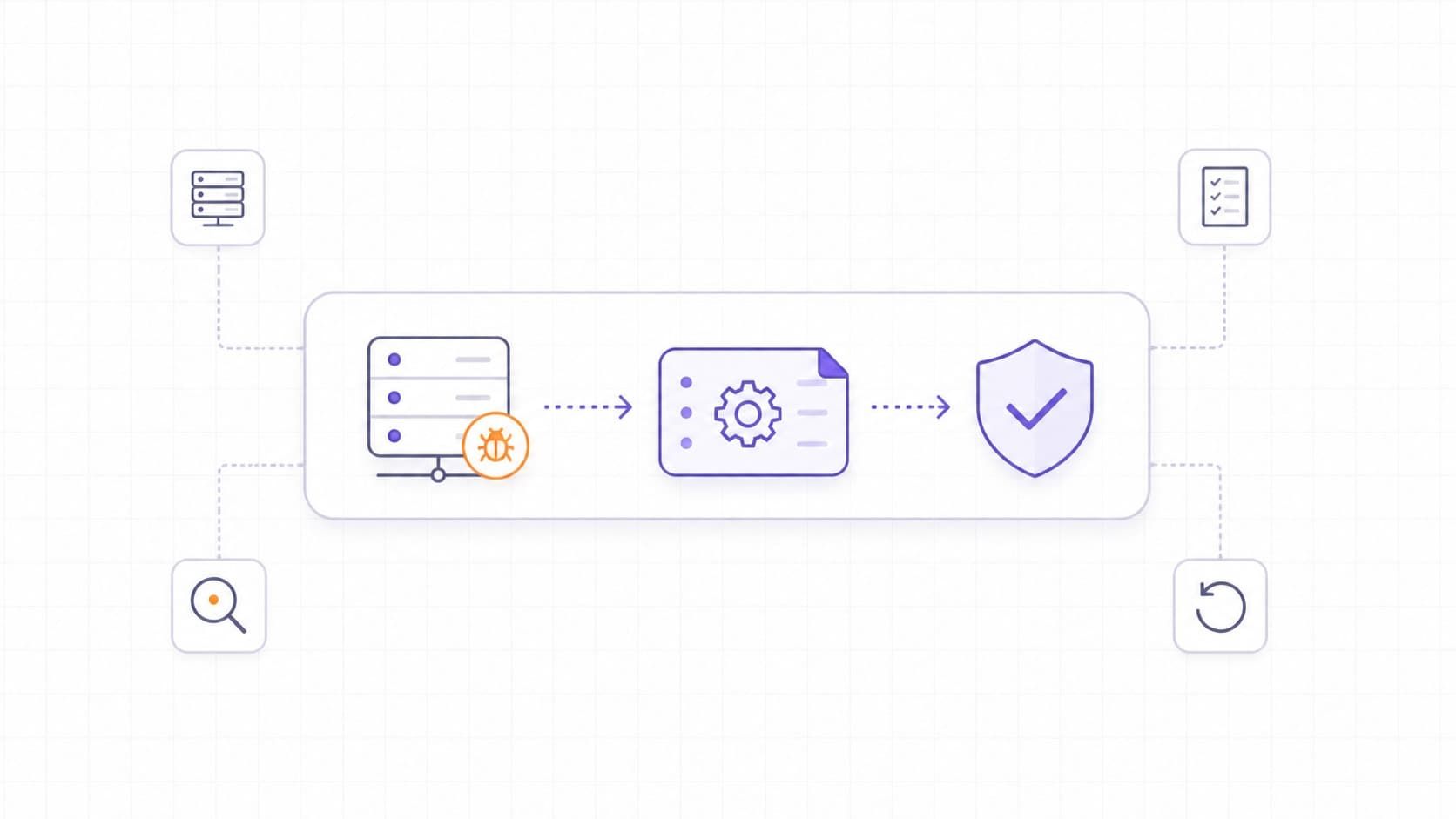
A vulnerability scan can identify thousands of potential problems. Risk falls only when the relevant findings become owned engineering work and the chosen action is verified.
Vulnerability remediation is the process of correcting a confirmed weakness or removing the condition that creates it. Depending on the finding, that may mean installing a patch, upgrading a component, changing a configuration, fixing code, rotating a credential, disabling an exposed feature, or retiring an unsupported system.
Remediation sits inside the broader vulnerability management lifecycle. The lifecycle also covers asset discovery, assessment, prioritization, ownership, exceptions, reporting, and continued monitoring. This distinction matters because a scanner can produce evidence, but it cannot decide whether a production change is safe or prove that the resulting risk is acceptable.
What Vulnerability Remediation Covers
A complete remediation decision has four parts: the affected asset and weakness are confirmed, an accountable owner is named, a treatment and deadline are approved, and closure evidence is defined in advance. A ticket that says "patch server" is incomplete if nobody knows which instance is affected, what version should replace it, or how success will be checked.
Patching is one remediation method, not a synonym for the whole practice. NIST defines enterprise patch management as identifying, prioritizing, acquiring, installing, and verifying patches, updates, and upgrades. It frames this work as preventive maintenance that must be planned and operationalized, rather than reserved for emergencies.
The following outcomes should remain distinct:
- The underlying weakness has been removed. Examples include upgrading a vulnerable library, correcting an access-control rule, or deleting an unnecessary public service.
- A compensating control reduces exposure or impact while the weakness remains. Restricting access to a trusted network can buy time, but the team still needs an owner, review date, and permanent plan.
- An authorized business owner has agreed to retain the residual risk for a defined period. The record should include the rationale, affected assets, current controls, expiry date, and conditions that trigger an earlier review.
- Not applicable or false positive. Evidence shows that the component, version, code path, or condition is absent. The decision should retain enough evidence for another reviewer to reproduce it.
A Repeatable Vulnerability Remediation Process
The exact labels vary by organization, but the workflow needs clear entry and exit criteria. The table below gives each stage a decision and a verifiable output.
|
Stage |
Decision |
Exit Criterion |
|
1. Confirm |
Does the finding affect an in-scope asset, and is the vulnerable condition present? |
The asset, component or configuration, supporting evidence, exposure, and owner are recorded. |
|
2. Prioritize |
How urgent is the issue in this environment? |
A priority and target date reflect severity, exploitation evidence, exposure, asset criticality, and change risk. |
|
3. Select a treatment |
Should the team patch, upgrade, reconfigure, fix code, mitigate, retire, or accept? |
The approved action, dependencies, owner, rollback plan, and closure test are documented. |
|
4. Implement |
Can the change be deployed safely and within the risk window? |
The change is completed through the appropriate test, approval, and deployment path. |
|
5. Verify |
Did the action remove or reduce the original exposure? |
A rescan or targeted test confirms the outcome, and relevant regression checks pass. |
|
6. Close and monitor |
Is there enough evidence to close the finding, and could it return? |
Status, timestamps, evidence, exception details, and any follow-up monitoring are retained. |
Confirm the Finding and the Asset
Start with the evidence, not the severity label. Confirm the affected hostname, application, repository, package, version, configuration, or endpoint. Check whether the relevant feature is enabled and reachable. Remove duplicates without losing the list of affected assets.
Scanner results can be wrong because version banners are incomplete, backported patches retain an older version string, an asset has changed since the scan, or a broad signature cannot prove that the vulnerable path is active. Safe validation may use authenticated checks, package inventories, configuration review, vendor guidance, or a focused scanner test. Intrusive validation on production systems requires explicit authorization and a defined test window.
Assign Ownership Before Setting the Deadline
Route the finding to the team that can change the affected service, then name a person responsible for the next action. A shared queue called "Infrastructure" does not establish accountability. The record should also identify who can approve downtime and who can accept residual risk if a permanent fix cannot meet the target date.
Ownership data often comes from a service catalog, cloud tags, repository metadata, or an asset inventory. When it is missing, treat that as a control gap. An urgent finding without an owner is already an escalation condition.
Define the Closure Test Before Making the Change
Write down what will prove the treatment worked. For a patch, that may include the installed build number and a clean targeted scan. For a configuration change, it may be a configuration query plus an external reachability test. For a code fix, it may include a regression test and a security test for the original path.
This step prevents a common failure: closing the finding when a package was deployed, even though one node, image, container, or environment still contains the vulnerable condition.
Risk-Based Prioritization Produces a Defensible Queue
CVSS is a useful description of technical severity, but a base score is not a complete remediation priority. The CVSS v4.0 specification says that organizations should enrich base metrics with threat and environmental information and consider factors outside CVSS when making remediation decisions.
A practical vulnerability prioritization decision combines several signals:
- Evidence of exploitation. A validated vulnerability in the CISA Known Exploited Vulnerabilities Catalog deserves prompt review because CISA has evidence of exploitation in the wild. Confirm that the listed product and affected version match the asset.
- Likelihood of near-term exploitation. EPSS estimates the probability that exploitation activity for a published CVE will be observed in the next 30 days. FIRST states that EPSS is neither a severity score nor a complete risk score, so use it with asset and impact context.
- Exposure and reachability. An internet-facing service or a component reachable from an untrusted network normally creates a shorter attack path than an isolated test system. Authentication, segmentation, and feature state can change that path.
- Business impact. Data sensitivity, service criticality, privilege level, operational dependency, and regulatory obligations shape the consequence of exploitation and the cost of a failed change.
- Fix readiness and change risk. A tested vendor patch supports a different plan from an unverified workaround on a fragile legacy service. This signal changes the treatment and timing, but it should not be used to hide the underlying risk.
Set internal remediation targets from this context and the organization's risk tolerance. Avoid copying universal deadlines such as "all critical findings in 24 hours." A critical, known-exploited flaw on a public authentication service may require containment within hours, while a similar base score on an isolated system may follow a controlled change window. Document the rule, the exception path, and who can approve a delay.
Editorial judgment: For a small team, a short queue of confirmed, exposed, high-impact findings are more actionable than a large queue sorted only by CVSS. This approach depends on reliable asset ownership and exposure data. If those inputs are weak, improve them while keeping credible urgent findings visible.
Choose the Treatment That Removes the Risk Safely
The treatment should match the root cause and operating constraints. The main options are:
- Patch or upgrade the component. Use the vendor's supported version and advisory, confirm prerequisites, test compatibility, and verify the deployed version. The difference between patch management and vulnerability management becomes clear here: one controls software updates, while the other decides which weakness needs which response.
- Correct the configuration. Disable an unused protocol, remove public access, tighten permissions, or restore an approved baseline. Make the durable change in the configuration source, such as infrastructure-as-code, so the next deployment does not recreate the weakness.
- Fix application code or dependencies. Trace the finding to the affected code path or package, create a reviewed change, run security and regression tests, and deploy through the normal release pipeline. A dependency update may require code changes when an upstream release removes or changes an interface.
- Apply a temporary mitigation. Restrict network access, disable the affected feature, add a narrowly tested filter, or increase monitoring when a permanent fix is not yet safe or available. Record what the control blocks, what it does not block, and when the decision will be reviewed.
- Remove or retire the asset. Decommission an unused service, revoke its credentials, remove routing and DNS records, and verify that the endpoint is no longer reachable. Simply turning off a virtual machine can leave snapshots, addresses, secrets, or deployment definitions that recreate the exposure.
Risk acceptance belongs in this decision set, but it does not fix the weakness. Use it only through an authorized, time-limited exception process with a named owner and review trigger.
Change Management Keeps Remediation from Creating an Outage
Urgency and operational safety have to be managed together. Before changing a critical service, identify dependencies, maintenance constraints, backups, rollback steps, and observable failure signals. Test in a representative environment when one exists, then use a canary or phased rollout if the architecture supports it.
The amount of process should match the risk. A routine dependency update in a non-production branch may need automated tests and peer review. An emergency change to an exposed production gateway may need rapid approval, immediate containment, a prepared rollback, active monitoring, and a focused verification scan. A full change advisory board meeting is not automatically safer if it delays action without improving the decision.
Automation is most reliable when it first improves handoffs: enrich the finding, identify the owner, open a ticket, attach evidence, set a review point, and trigger a rescan.
The guide to automating vulnerability management explains why production fixes should remain within narrow, tested, and approved runbooks.
Common Remediation Failures and Their Corrections
Treating Every Scanner Result as Confirmed
Blindly routing raw output wastes engineering time and can create unsafe emergency work. Preserve the finding, validate applicability, group duplicates around the root cause, and escalate credible high-risk exposure while deeper validation continues.
Using Severity as the Only Priority
A base score does not show whether the asset is exposed, important, protected by controls, or already targeted. Add KEV status, EPSS, reachability, business impact, and treatment feasibility. Record uncertainty instead of hiding it inside a composite score that nobody can explain.
Closing Tickets Without Verification
Deployment success is not security success. A package manager can report a completed update while an old container image remains in use or one cluster node misses the change. Require evidence that tests the original condition on the affected asset.
Allowing Temporary Controls to Become Permanent
A firewall rule or disabled feature may reduce immediate exposure, but it can drift, be bypassed by another path, or remain after its owner leaves. Give every mitigation an expiry date, review trigger, and permanent remediation plan.
Losing Findings Between Security and Engineering
Scanner dashboards, spreadsheets, chat threads, and ticketing systems can each hold part of the record. Use one traceable identifier and keep the evidence, owner, deadline, treatment, exception, and verification result connected. Measure handoff failures as well as fix time.
The Equifax Case Shows Why Verification Matters
The 2017 Equifax breach is a documented example of a remediation process failing even after a critical patch alert was issued. A report by the U.S. House Committee on Oversight and Government Reform states that Apache released a patch for CVE-2017-5638 on March 7, US-CERT notified Equifax on March 8, and Equifax's internal message required patching within 48 hours. The vulnerable system was not patched before attackers later entered through the Apache Struts flaw.
The report also says the scans used during the response failed to identify the vulnerable component. One scan looked in the wrong directory, and external scans did not find the affected installation. The operational lesson is specific: sending an alert, assigning a deadline, and running a scan are not sufficient closure evidence. Teams need accurate software inventory, accountable application ownership, validation suited to the deployment, and a test that confirms the vulnerable condition is gone from the actual system.
Validate, Report, and Improve the Program
Verification should reproduce the original detection as closely as safety allows. Rescan the affected asset, query the installed version or configuration, test the original endpoint or code path, and run relevant regression checks. If a temporary mitigation was used, confirm both that it works and that monitoring can detect bypass or failure.
Keep closure evidence with the finding: affected asset, action, change reference, deployed version or configuration, validation method, result, timestamps, and reviewer. Reopen the same record if the weakness returns so the history exposes recurring root causes.
Use a small set of metrics that supports decisions:
- Verified closure rate. Measure the share of closed findings with evidence that the original condition was removed or reduced. This discourages teams from treating ticket status as proof.
- Time by workflow stage. Separate time to validate, assign, implement, and verify. A single mean time to remediate can hide whether the bottleneck is triage, ownership, change approval, or testing.
- Overdue high-risk findings and exceptions. Show which confirmed findings missed their target and which accepted risks are nearing review or expiry. Include the owner and affected business service.
- Reopen and recurrence rate. Track findings that return after closure and root causes that appear across assets. Repetition often points to an outdated base image, unmanaged configuration, or incomplete deployment process.
- Coverage and ownership gaps. Report in-scope assets that are not scanned, cannot be authenticated where required, or have no confirmed owner. A fast remediation metric means little if critical systems are absent from the program.
Leadership reporting should explain exposure and decisions rather than repeat scanner counts. Show the highest consequential open risks, overdue work, approved exceptions, remediation trend, coverage gaps, and changes needed from engineering or business owners.
TopScan Connects External Findings to Verified Follow-Up
For teams managing internet-facing assets without a large security function, the TopScan vulnerability management platform brings findings, severity-based deadlines, issue states, false-positive handling, and reopened issues into one workspace. Its current product page describes lifecycle states, custom SLA settings, and reporting for external infrastructure and web application findings.
TopScan supports the workflow around remediation; it does not replace service ownership, patch deployment, production testing, incident response, or a business decision to accept risk. The useful handoff is a traceable path from an external finding to an owner, deadline, recorded action, and verified result.
Build a Fix-and-Verify Loop Your Team Can Sustain
Start with a narrow scope: business-critical and internet-facing production assets, their owners, and an approved validation method. Define priority rules, exception authority, closure evidence, and a review cadence before the backlog grows. Then connect discovery, ticketing, change management, verification, and reporting so a finding cannot disappear between tools.
The standard for completion is simple to state and demanding to operate: the relevant weakness is confirmed, the response is proportionate, the change is safe, and evidence shows that exposure was removed or deliberately reduced. A repeatable fix-and-verify loop produces more defensible risk reduction than a growing list of alerts marked complete.